Last updated: August 2026
Search “fully funded master’s programs in USA” and you’ll find dozens of near-identical listicles naming dozens of scholarships — many with names that don’t turn up on any university or funder’s actual website when you check. Before you build an application strategy around any specific name, it’s worth separating the well-documented, verifiable national programs from the vaguer entries that circulate across scholarship content without a checkable source. Here’s what holds up.
An Important Correction First: The F-1 Visa Does Not Lead Directly to a Green Card
This is worth clearing up before anything else, since it’s a common and consequential misconception. The F-1 student visa is a “nonimmigrant intent” visa — to get it, you had to demonstrate you intend to return home after your studies, not that you intend to stay permanently. There is no direct or automatic pathway from F-1 status to a green card.
What’s actually possible: after completing your degree, most international students use Optional Practical Training (OPT) — typically 12 months, extendable to 36 months total for STEM fields — to gain US work experience. From there, a path to permanent residency generally requires an employer-sponsored visa like the H-1B (which does recognize “dual intent,” unlike F-1) followed by an employment-based green card category (EB-2 or EB-3), or a self-petition route like EB-1A or EB-2 NIW for those who qualify. This process commonly takes several years and depends heavily on your field, employer, and country of birth (which affects visa backlog timing). If long-term US residency is part of your planning, it’s worth consulting an immigration attorney early rather than assuming your student visa creates a direct route.
Donating Your Car to Charity: What You Can Actually Deduct
Programs That Check Out
Fulbright Foreign Student Program
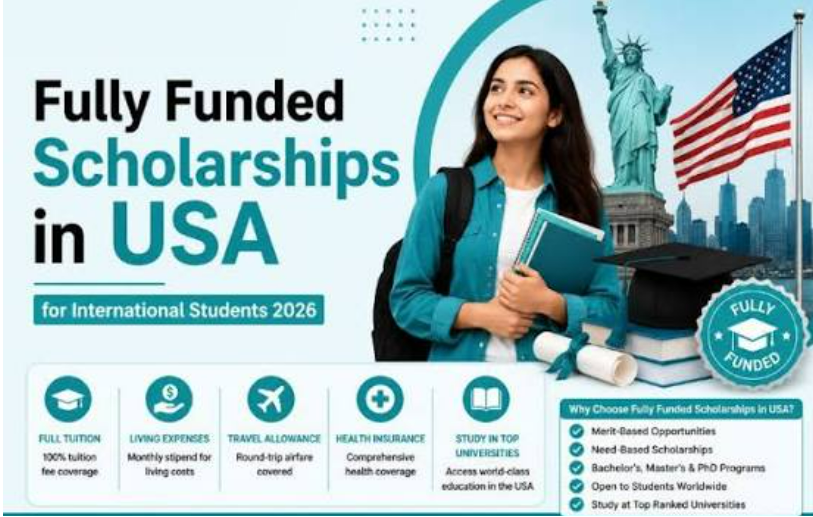
The most well-documented, broadly available fully funded option on this list. Fulbright funds graduate study (including master’s degrees) for international students across nearly all fields, at universities throughout the US, administered through Fulbright Commissions or US Embassies in each eligible country. Funding typically covers tuition, living stipend, airfare, and health insurance. Because it’s administered country-by-country, eligibility criteria, application timelines, and available fields can vary significantly depending on where you’re applying from — always check your specific country’s Fulbright Commission page rather than a generic US-wide description.
Hubert H. Humphrey Fellowship — Important Correction
This program is frequently listed alongside master’s degree scholarships (including in the source list for this article, under MPH, MPA, and MSc categories) — but that’s a mischaracterization worth correcting: the Humphrey Fellowship is explicitly a non-degree program. It brings accomplished mid-career professionals to the US for a 10-month period of graduate-level coursework, leadership development, and professional collaboration — fellows are placed at US host universities but do not earn a master’s degree, and cannot transfer from non-degree to degree status during the program. It’s a genuinely valuable professional development opportunity, funded by the US government, but if your goal is specifically to earn a master’s degree, this isn’t the vehicle for that.
Joint Japan/World Bank Graduate Scholarship Program (JJ/WBGSP)
Real, active, and currently funding master’s study — but the source description (“Universities in the USA”) understates its actual scope and eligibility. JJ/WBGSP funds master’s degrees at 41 specific “Participating Programs” at universities across the US, Europe, Africa, Oceania, and Japan — not a general USA-wide scholarship. It’s specifically for citizens of eligible developing countries with relevant professional experience in development-related work, and crucially, you must already be unconditionally admitted to one of the specific participating master’s programs before you can even apply for the scholarship itself — it isn’t a standalone application. Benefits include tuition, a living stipend, round-trip airfare, health insurance, and a travel allowance, for the duration of the program or up to two years, whichever is shorter.
Mastercard Foundation Scholars Program at UC Berkeley
This one checks out, with a scope correction: it’s specifically the UC Berkeley campus (not “University of California” as a system), and it’s specifically for academically talented students from Africa who’ve faced barriers to accessing higher education — not open to international students generally. Scholars receive comprehensive funding covering the full cost of their master’s degree, along with mentoring, career support, and an expectation (though not a strict legal requirement) that scholars return to their home country after graduation to apply what they’ve learned. The program plans to support over 200 master’s students through 2030.
What to Watch For: The Pattern Behind Unreliable Scholarship Lists
A significant number of entries commonly seen in “fully funded master’s in USA” content — vague names like an unnamed “NextGen Scholarship,” an “MFA Cinder Scholarship,” a “Bruce K. Lee Scholarship,” or institution names that don’t match reality (like “Cincinnati University,” when the actual institution is the University of Cincinnati) — could not be independently verified against any university or funder’s official page in the research for this article. This is a known pattern in low-quality, mass-produced scholarship content, sometimes generated with AI assistance and republished across many sites without anyone checking the underlying names against a real source.
Before you spend time on an application for any scholarship you found on a listicle:
- Search the exact scholarship name plus the university’s own domain (e.g., “[scholarship name] site:nyu.edu”) to confirm it appears on the institution’s actual financial aid or admissions page.
- Check the university’s general international student scholarships/financial aid page directly, rather than trusting a third-party summary — legitimate university-specific awards (need-based MBA fellowships, law school merit scholarships, arts program awards) do exist widely, but they’re described accurately only on the institution’s own site.
- Be skeptical of suspiciously specific dollar figures with no clear source (“up to $4,000,” “up to $8,000”) attached to a scholarship name that doesn’t independently turn up elsewhere — this is a common marker of recycled or fabricated listicle content.
Frequently Asked Questions
Does an F-1 student visa qualify me to apply for a green card? Not directly. F-1 is a nonimmigrant intent visa with no automatic pathway to permanent residency. Most international students transition through OPT, then an employer-sponsored dual-intent visa like H-1B, before pursuing a green card — a process that typically takes years.
Is the Hubert Humphrey Fellowship a master’s degree program? No — it’s explicitly a non-degree, 10-month fellowship focused on leadership development and professional collaboration, even though fellows study at a US host university.
Can any international student apply for the Joint Japan/World Bank Graduate Scholarship? No. It’s restricted to citizens of eligible developing countries with relevant professional experience, and you must already be unconditionally admitted to one of 41 specific participating master’s programs worldwide before you can apply for the funding itself.
Is the Mastercard Foundation Scholars Program open to all international students? No — it’s specifically for academically talented students from Africa applying to UC Berkeley’s master’s programs, not a general international scholarship.
How can I tell if a scholarship I found online is real? Search for the exact scholarship name alongside the named university’s own website domain. If it doesn’t appear on the institution’s actual admissions or financial aid pages, treat the listing with real skepticism before investing time in an application.
This guide reflects publicly available information as of August 2026, verified directly against official program and university sources where possible. Always confirm current eligibility, deadlines, and award amounts directly with the funding organization or university before applying.